
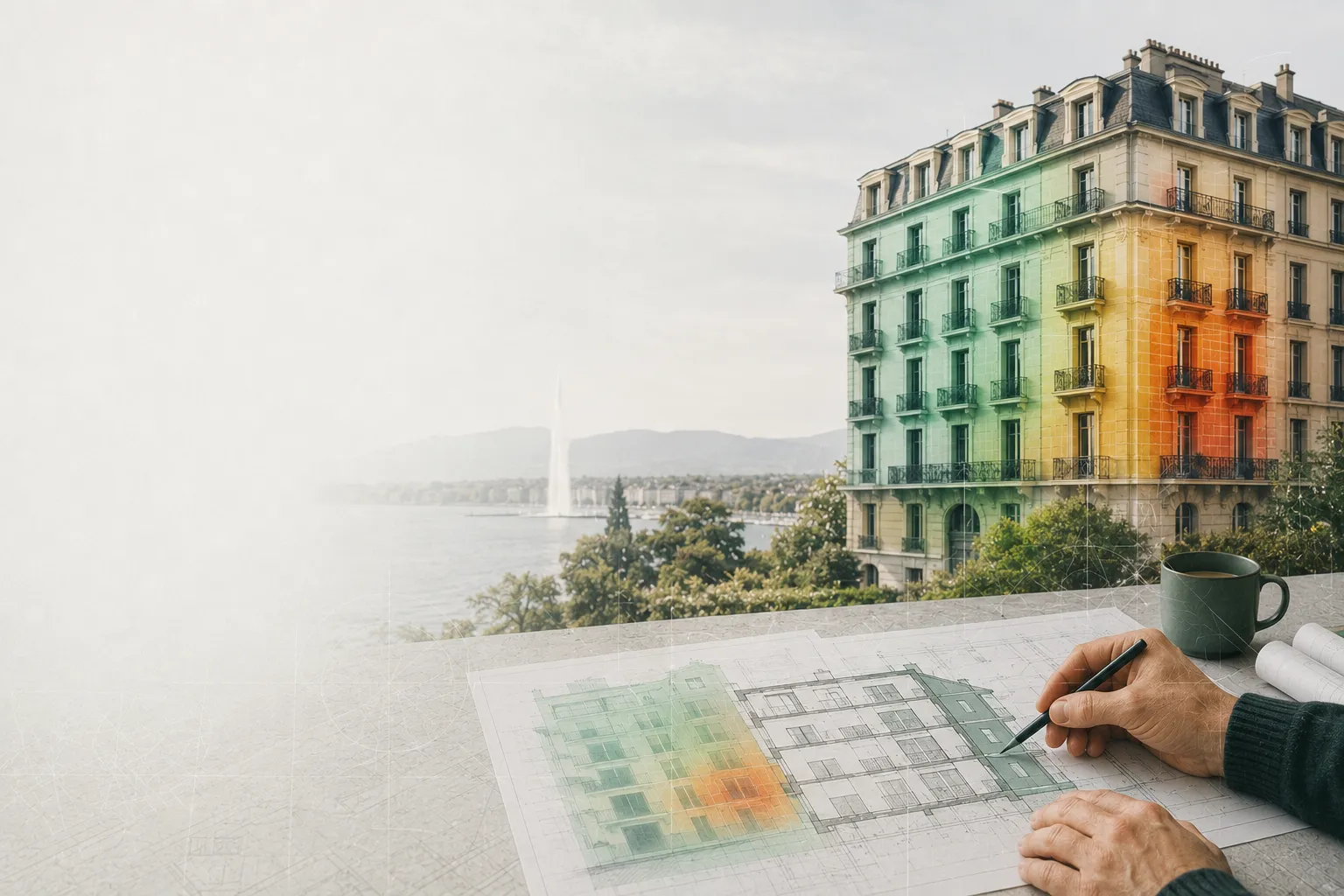
In Geneva, a building that consumes too much heat is not just expensive: it can oblige its owner to renovate it. The canton measures this consumption with the IDC, and the threshold not to be exceeded tightens in 2027 and again in 2031. Here is what every Geneva owner needs to anticipate.
The IDC, Geneva's energy thermometer
The heat-expenditure index expresses, in kWh (or MJ) per square metre per year, the energy a building consumes for heating and hot water. The higher it is, the more energy-hungry the building. In Geneva, building owners must declare their building's IDC, which allows the canton to identify the biggest consumers.
Thresholds that tighten
The "significant excess" threshold — the one that triggers obligations — falls in steps:
| Period | Significant-excess threshold |
|---|---|
| Until 31.12.2026 | 800 MJ/m²/year (≈ 222 kWh/m²/year) |
| From 01.01.2027 to 31.12.2030 | 650 MJ/m²/year (≈ 180 kWh/m²/year) |
| From 01.01.2031 | 550 MJ/m²/year (≈ 153 kWh/m²/year) |
In other words, a building that is "borderline" today may find itself above the threshold in 2027 without having changed anything — simply because the bar has been lowered.
The obligation to renovate
When the IDC significantly exceeds the threshold, the owner is under an obligation to carry out energy works to bring consumption below a target value (of the order of 450 MJ/m²/year). These works notably include:
- insulating the envelope (walls, roof, basements);
- replacing the windows;
- installing solar thermal or photovoltaic panels;
- heat recovery.
Heating: phasing out fossil fuels
Alongside the IDC, Geneva strictly regulates fossil fuels: the canton has banned new fossil installations in new builds since 2020, and the energy regulation provides for replacing fossil with renewable at the time the heat-production installation is changed. Replacing a boiler is therefore, in Geneva more than elsewhere, the occasion (or the obligation) to switch to a heat pump or to connect to a district heating network — a point developed in our guide on replacing a fossil heating system.
What this means for you
Know your building's IDC
This is the starting point: it places your building relative to the current and future threshold.
Anticipate the 2027 step
A building just under 222 kWh today can tip over 180 kWh in 2027. Better to plan than to be caught out.
Tap into the available support
Energy renovation is subsidised in Geneva. Estimate your support before costing the works with the subsidies calculator.
The IDC says what your building consumes; it says nothing about what your plot allows. Yet a heavy renovation is often the occasion to rethink the property — even to enlarge it or add a storey if the zone permits. Before starting a project, it is worth clarifying both: the energy obligation on one side, the building potential on the other.