
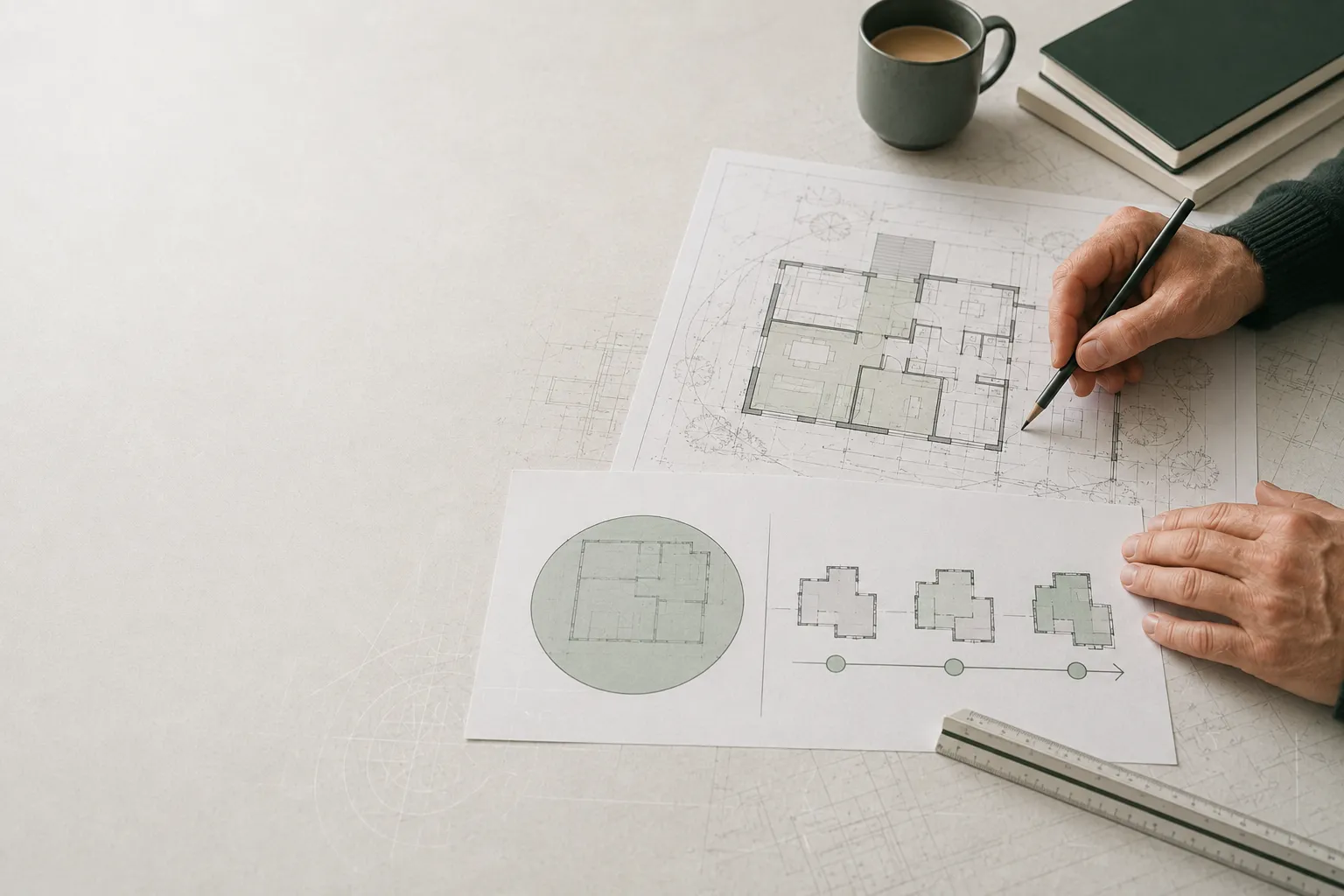
Should you renovate everything at once, or move forward in stages according to your budget? This choice has concrete consequences: on the amount of support you receive, on your energy bill, and on the risk of having to redo work. Here is how to decide — and, above all, in what order to act so that nothing goes to waste.
Two strategies, two logics
- Whole-building renovation: you tackle the envelope (insulation, windows) and the heating in a single project. Heavier to finance, but more coherent, higher-performing, and better subsidised.
- Renovation in stages: you advance measure by measure, as budget allows and equipment wears out. More accessible, but the final result depends on the coherence between the stages.
The "whole-building renovation" bonus
The Buildings Programme rewards coherence: a whole-building renovation can be supported up to around 30 % of the investment, whereas isolated measures qualify for more modest flat rates. The logic is simple: insulating and changing the heating in one go produces a markedly higher-performing building than a succession of partial steps.
The order of works that avoids waste
Whether you renovate all at once or in stages, the sequence is the same — reversing it is costly:
1. The envelope first
Insulation of the roof, walls and floors, and windows. It is the envelope that reduces heat demand — and therefore the size (and cost) of the heating system to be installed afterwards.
2. The heating next
Once demand has been reduced, you correctly size a heat pump or a renewable solution — without oversizing it. See our guide on replacing a fossil-fuel heating system.
3. Solar to finish
Once consumption is under control, photovoltaics cover part of the remaining needs.
Working in stages without closing doors
If the budget calls for spreading the work out, a few principles will spare you regrets:
- Plan the target from the outset (an energy audit, a CECB Plus, maps out the trajectory) so that each stage fits into a coherent whole.
- Group what belongs together: redo the façade and insulate it at the same time, change the windows when you insulate the walls.
- Don't oversize a piece of equipment by betting on insulation "that will come one day".
Renovate, or think bigger?
A major renovation is sometimes the chance to do more: add a storey, extend, reorganise. That trade-off depends not on the support available but on what the plot allows — zone, index, building envelope. Before locking in a renovation project, it is worth checking whether the property has untapped building potential: this can turn a simple renovation into a far more profitable enhancement of the asset.